Research Archive
Simulation of climate of last glacial maximum
- Climate model integrations for present day and 21,000 years before present have been completed using R30L20 atmosphere-mixed layer ocean model with sea ice dynamics. These integrations follow the specifications of the Paleoclimate Model Intercomparison Project (PMIP), and output from them has been submitted to the PMIP archive.
- An analysis of simulated tropical temperatures, with emphasis on the spatial patterns of temperature change, the mechanisms responsible for those patterns, and a comparison with paleotemperature estimates, has been accepted for publication in Journal of Climate, and is scheduled to appear in early 2000.
Abstract
Preprint (postscript, text only, 1.1 MB)
Figures (color postscript, 6.3 MB)
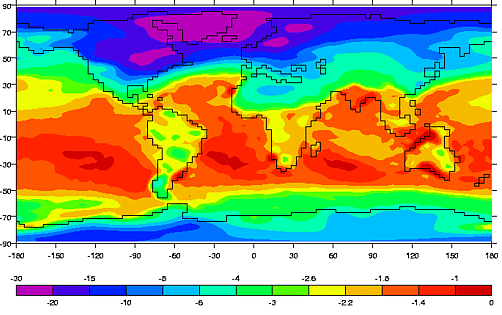
Annual mean surface air temperature difference (degrees Celsius) between 21K B.P. and modern integrations of the R30L20 atmosphere-mixed layer ocean model.
Trends in the Arctic Oscillation (with Tom Delworth and Gabriel Lau)
- The Arctic Oscillation (AO), as defined by Thompson and Wallace (Geophysical Research Letters, 1998), is a mode of atmospheric variability that extends from the lower stratosphere to the surface and is characterized by a zonally symmetric redistribution of atmospheric mass between the Arctic and midlatitudes, Observations indicate that the AO has exhibited a positive trend (i.e., toward stronger subpolar westerlies) since the late 1960s.
- Our goals are to understand (1) if this trend is of climatic significance, (2) its impact on surface temperature trends, and (3) the role, if any, of anthropogenic forcing. We are using a combination of observational diagnostics and climate modeling to address these issues.
Analysis of cold ocean-warm land pattern in long climate integrations (with Gabriel Lau and Mary Jo Nath)
- Long integrations of a variety of climate models have been analyzed to determine if the cold ocean-warm land (COWL) pattern first identified by Wallace et al. (Science, 1995) is reproduced in these models. Our goal is to better understand the physical significance of this pattern, and to investigate whether the removal of the contribution of this pattern to the observed climate record can aid in climate change detection. A paper describing the results of this research appeared in the November 1998 issue of Journal of Climate.
Abstract
Preprint (postscript, text only, 322K bytes)
Figures (color postscript, 9.5M bytes)
Distribution of the structure function A(x) for surface air temperature from (a) the 1000-year coupled model integration, and (b) observations during the 1900-1995 period. Temporal fluctuations of this structure function are strongly related to fluctuations of the spatial mean temperature. For both the model and observations, the spatial domain of the analysis is restricted to land north of 20N. Contour interval is 0.5. Positive (negative) values are shaded in red (blue). Unshaded land areas in (b) correspond to sites with inadequate data records during 1900-1995.